Executive Summary
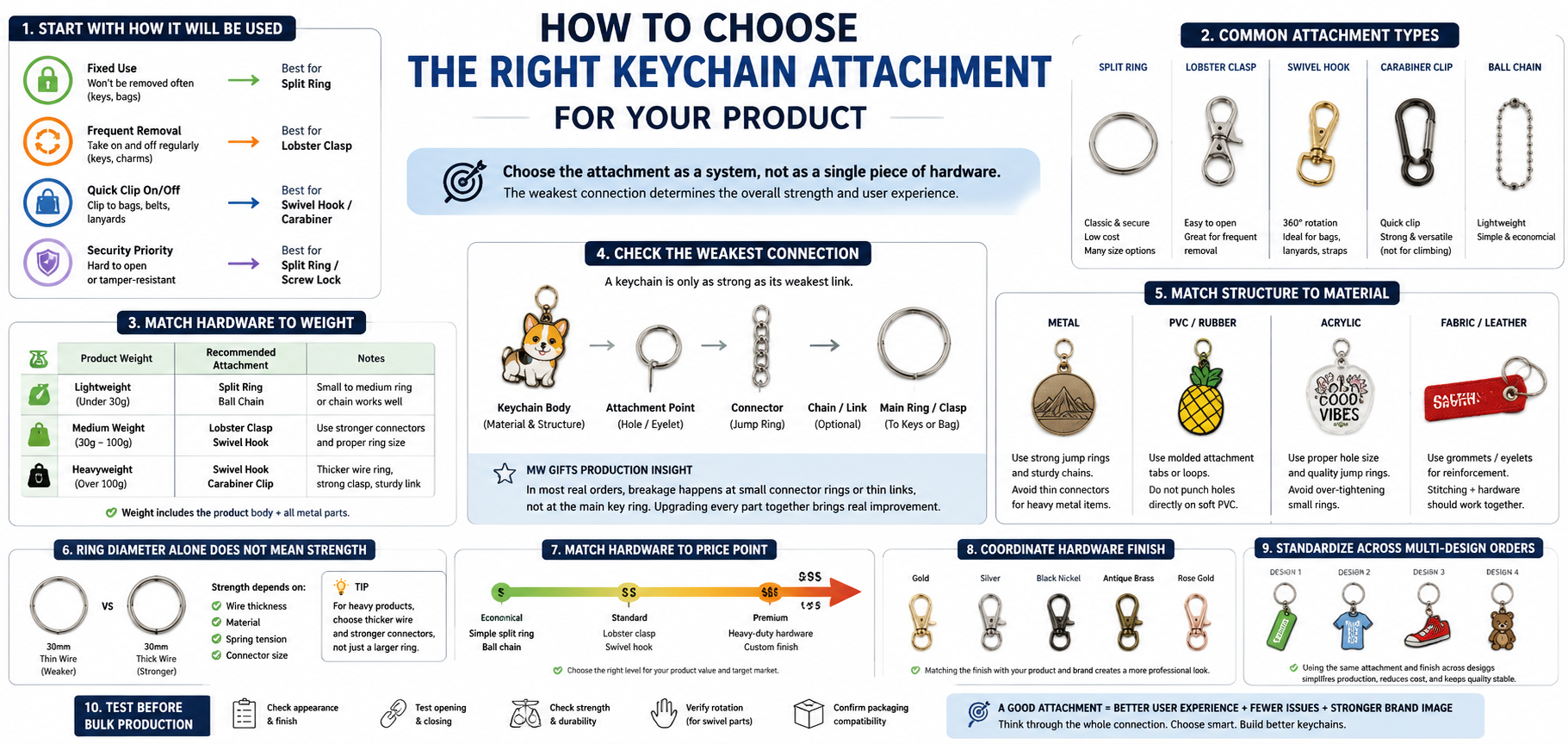
The right keychain attachment depends first on how the finished product will be used. A split ring is usually the safest starting point for everyday keys and permanent use. A lobster clasp makes more sense when users need to remove or move the keychain frequently. Swivel hooks work well on bags, wristlets, straps, and products that move during use, while carabiner-style clips suit fast attachment to loops and backpacks.
But attachment choice should not stop at the visible ring or clasp. Product weight, material, connector strength, finish, retail position, and the weakest point between the charm and the hardware all matter.
A useful rule is:
User behavior + product weight + product material + connection structure + price point = the right keychain attachment.
More importantly, choose the attachment as a complete connection system, not as one individual piece of hardware.
Quick Keychain Attachment Selection Guide
| Use / Product | Start With | Main Check |
|---|---|---|
| Everyday keys | Split ring | Secure hold |
| Removable charm | Lobster clasp | Easy removal |
| Bag / wristlet | Swivel hook | Rotation |
| Backpack / belt loop | Carabiner-style clip | Opening size |
| Lightweight giveaway | Standard ring / ball chain | Avoid over-specifying |
| Heavy metal keychain | Reinforced connection system | Connector + chain |
| PVC keychain | Split ring / clasp | Molded attachment tab |
Use this table as a starting point. The first question is whether the keychain should stay attached for everyday use or be removed and repositioned frequently. Product weight, material and connection structure should then be checked before the final hardware is approved.
Compare the Main Keychain Attachment Types
Most custom keychain projects can start with five common attachment types. The best option depends on how the product will be used and how often the user needs to remove it.
| Attachment | Meilleur pour | Main Advantage | Main Limitation |
|---|---|---|---|
| Anneau fendu | Everyday keys, souvenirs | Secure and economical | Slower to remove |
| Fermoir en forme de homard | Removable charms, bag accessories | Quick attachment and removal | More moving parts |
| Crochet pivotant | Wristlets, straps, bag charms | Rotates to reduce twisting | Larger than a simple ring |
| Carabiner-Style Clip | Backpacks, belt loops | Fast clipping with a wide opening | Promotional versions are not safety equipment |
| Ball Chain | Lightweight giveaways and tags | Lightweight and low cost | Not ideal for heavy metal products |
Anneau fendu
A split ring is the standard choice for everyday keys, souvenirs and many promotional keychains. It offers a secure, familiar connection at a relatively low cost. Choose it when permanent attachment matters more than quick removal.
Fermoir en forme de homard
A lobster clasp is easier to open and close, making it useful for charms that move between bags, zippers or accessories. It suits products where convenience matters more than permanent attachment.
Crochet pivotant
A swivel hook combines a clasp with a rotating joint. It works well for wristlets, straps and bag accessories that move during use because the swivel allows the hanging product to rotate more freely.
“Swivel” describes a rotating feature, not always a completely separate clasp type.
Carabiner-Style Clip
Carabiner-style clips provide a wider opening for fast attachment to backpacks, belt loops and similar points. Promotional versions should be treated as accessory hardware, not climbing or life-safety equipment unless specifically designed and certified for that purpose. For comparison, the UIAA safety standards for mountaineering connectors cover safety-rated climbing and mountaineering equipment, which is a very different category from promotional carabiner-style keychain clips.
Ball Chain
Ball chain is lightweight, flexible and inexpensive. It works best for lightweight charms, tags and cost-sensitive promotional items rather than heavy metal keychains.
Match the Attachment to Product Weight
Product weight affects how much stress the attachment experiences during everyday movement. A lightweight PVC charm and a thick 3D metal bottle opener do not need the same hardware setup.
The goal is not to use the largest attachment available. It is to choose hardware that matches the finished product without adding unnecessary size or cost.
| Product Weight / Type | Typical Examples | Hardware Direction | Main Concern |
|---|---|---|---|
| Lightweight | Small PVC, acrylic charms, giveaways | Standard ring, clasp or ball chain | Avoid oversized hardware |
| Standard | Flat metal souvenirs, enamel keychains | Standard split-ring system | Balance function and cost |
| Heavy / Functional | Thick zinc alloy, 3D keychains, bottle openers | Stronger attachment system | Review the complete connection |
Lightweight Products
Small PVC keychains, acrylic charms and lightweight promotional items usually do not need oversized hardware. A larger clasp can add cost and bulk without improving the way the product is actually used.
Standard Metal Keychains
Standard metal souvenirs and flat keychains can often use a conventional split-ring setup. The hardware should feel proportionate to the finished product and match its intended use and price point.
Heavy or Functional Keychains
For these products, the next step is to review the entire connection system rather than simply choosing a larger main ring.
Thick zinc alloy pieces, 3D designs, bottle opener keychains and multi-function products may need a stronger attachment setup because the finished product creates more stress during movement.
Check the Complete Connection System
This is one of the most important checks in a custom keychain order.
The most visible component is often the large split ring, so buyers naturally focus on it. In practice, the failure point can sit somewhere else.
MW Gifts Production Insight
In our keychain production projects, one area we pay close attention to is the small connection between the decorative body and the chain.
A strong outer key ring does not solve the problem if the smaller connector is the weakest part of the assembly.
For heavier or higher-value keychains, review the connector, chain and main ring as one complete system.
That means the attachment should be reviewed as a complete load path:
Product body
↓
Connector ring or attachment point
↓
Chain or short connector
↓
Main ring, clasp, or hook
Strengthening one component does not solve the problem if another connection remains too light for the finished product. For heavier or higher-value keychains, check the connector, chain and main hardware together rather than relying on a “heavy-duty” main ring alone.
Before approval, check:
- Is the connector proportionate to the charm?
- Could the connector open during repeated movement?
- Does the chain move freely?
- Does the complete assembly suit the finished product weight?
Connection Structure by Product Material
Material also affects how the keychain body connects to the hardware. If you are still deciding between acrylic, PVC and metal, our keychain material comparison explains the differences in weight, feel, design flexibility and typical use.
Metal Keychains
Custom metal keychains may connect through a molded or punched attachment point, a small connector ring and sometimes a short chain.
Because the body itself is rigid, the smaller connector and chain often deserve more attention on heavier metal designs.
PVC Keychains
Custom PVC keychains use a different connection structure.
Instead of placing the attachment hole inside the main decorative area, a small molded tab can extend outside the PVC body to hold the hardware.
The structure looks like this:
Main PVC design → Molded attachment tab → Hole → Connector → Chain or ring
This keeps the main artwork intact while giving the hardware a dedicated connection point.
The attachment tab should be included in the production artwork from the beginning. When reviewing the digital proof, check the complete product shape and hardware placement rather than approving only the decorative design.
Acrylic Keychains
Acrylic keychains need a defined attachment position in the production artwork. Buyers should confirm the hole or connector location, hardware type and final scale before approval so the finished attachment matches the intended use.
Fabric and Woven Key Tags
Fabric and woven key tags may use a sewn loop, metal eyelet or another reinforced connection before the main ring is attached.
The textile connection and hardware should be reviewed together rather than treating the ring as a separate component.
The material changes the connection method, but the buying principle stays the same: review how the product body transfers movement into the hardware.
Check Ring Size, Hardware Quality and Finish
A specification such as “25 mm split ring” or “30 mm key ring” describes size, but diameter alone does not tell you how strong or substantial the hardware will feel.
Two rings with a similar outside diameter can still differ in:
| Hardware Detail | Pourquoi c'est important |
|---|---|
| Ring Diameter | Affects size and proportion, but not strength alone |
| Wire Thickness | Influences the feel and robustness of the ring |
| Spring Tension | Affects how firmly the split ring closes |
| Material and Profile | Can change stiffness and everyday performance |
| Connector Size | Should match the charm, chain and finished product weight |
| Finition | Should coordinate with the product without adding unnecessary complexity |
For heavy, frequently used or higher-value keychains, ask to see or sample the actual hardware rather than comparing ring diameter alone.
Hardware finish also affects the appearance of the finished product. Polished silver, gold-tone, antique and dark metal products usually look more intentional when the visible ring, connector and clasp use a compatible finish.
However, special plating is not necessary for every order. If a standard hardware finish already works with the product, adding another finish can increase production complexity without creating enough additional value.
Choose hardware by specification and product fit first; use special finishes when they support a clear product concept.
When Upgraded Hardware Is Worth the Cost
| Upgrade Hardware When | Standard Hardware Is Usually Enough When |
|---|---|
| The keychain is heavy or functional | The product is lightweight |
| Users will clip and remove it frequently | The attachment is rarely operated |
| Hardware is visible on a premium retail product | The item is a low-cost giveaway |
| The clasp contributes to perceived value | Standard hardware already suits the product |
The goal is not to specify the most expensive hardware. Upgrade it when the user can benefit from the stronger function, easier operation or better presentation.
Standardize Attachments Across Multi-Design Orders When It Makes Sense
Bulk keychain programs often contain more than one design.
A museum may order several exhibits. A visitor attraction may carry different animals or landmarks. A retailer may launch a collection of ten regional designs at the same time.
If those products share similar:
- materials;
- dimensions;
- weights;
- uses;
- price points;
using one attachment specification across the collection can simplify the order.
Standardization can reduce:
- hardware SKU count;
- sourcing complexity;
- assembly variation;
- packing mistakes;
- replacement-stock confusion;
- reorder complexity.
It also makes the collection feel more consistent at retail.
Suppose a souvenir range includes eight metal keychains of similar size and weight. Using the same split ring, connector, chain length, and finish across all eight may be more practical than creating eight slightly different hardware specifications.
But standardization has limits.
Do not force the same attachment onto products with clearly different structural requirements.
A lightweight PVC charm and a heavy 3D metal bottle opener may belong to the same collection while needing different hardware.
A better rule is:
Standardize where product requirements are similar, not simply because the designs appear in the same order.
This gives buyers the cost and operational benefits of standardization without weakening products that need stronger hardware.
Test the Attachment Before Approving Bulk Production
Digital artwork can confirm the position and appearance of hardware, but it cannot fully show how an attachment feels. Before approving the digital proof, check the connector location, PVC attachment tab when applicable, hardware finish and overall scale—not only the decorative artwork.
A physical sample becomes useful when the project depends heavily on:
- clasp operation;
- spring tension;
- product balance;
- connector movement;
- perceived hardware quality;
- a special finish;
- a heavy charm;
- a new attachment structure.
During sample review, do more than look at the logo.
Operate the hardware.
Open and close the clasp several times. Move the charm through its full range. Hold the product by the ring and let the body hang naturally. Check whether the chain twists awkwardly or whether the connector looks too light relative to the charm.
For a removable clasp, ask:
Can a typical user operate it comfortably?
For a permanent split ring, ask:
Does it hold securely without feeling unnecessarily difficult to use?
For a swivel hook, confirm that the rotating joint moves as intended.
For heavier products, inspect the small connector between the product and chain—the point that deserves particular attention based on our production experience.
Sampling should focus on the actual risk of the project. A simple repeat order using a proven standard attachment may not need the same level of hardware evaluation as a new heavy metal product with an unfamiliar clasp.
What to Send Before Sampling or Quotation
Buyers do not need to know every ring diameter, spring mechanism, and connector specification before requesting a quotation.
A good supplier should be able to recommend a starting configuration after reviewing the product.
Send:
- artwork or a clear product concept;
- intended material;
- finished size;
- approximate thickness;
- intended use;
- quantity;
- whether the item needs frequent removal;
- whether it will carry keys, hang from a bag, or work mainly as decoration;
- preferred metal finish;
- expected retail or gift position;
- any existing attachment requirement.
The supplier can then evaluate the hardware in context.
The more context you provide, the easier it is to recommend suitable hardware. For example, “a lightweight retail charm that customers will move between handbags” gives the supplier more useful information than simply requesting a lobster clasp.
Likewise, describing a product as “a large metal bottle opener that will carry several keys every day” is more useful than asking only for a “strong ring.”
Final Buying Decision
The right keychain attachment should match the way the finished product will actually be used.
A split ring works well for secure everyday attachment, while lobster clasps, swivel hooks and carabiner-style clips make more sense when quick removal, rotation or fast clipping matters.
More importantly, review the complete connection system. The product body, connector, chain and main hardware should work together rather than relying on one oversized or premium-looking component.
For bulk orders, choose hardware that gives the finished keychain the right balance of function, durability, appearance and cost. Standardize the attachment across similar designs when practical, and use a physical sample when fit, movement or hardware feel needs confirmation.
MW Gifts can review your artwork, product material, size, intended use and quantity before recommending a suitable attachment setup.